
That burning pain in the ball of your foot isn’t something to brush off.
Does it feel like you’re walking on a pebble that isn’t actually there? Or like a sharp, burning pain shoots into your toes after a long day, a workout, or a pair of not-so-friendly shoes?
You’re definitely not imagining it.
Forefoot pain is one of the most common reasons people come to see a podiatrist. And while it often gets blamed on “just getting older” or “wearing the wrong shoes”, the real cause is usually something very treatable.
One of the most common culprits is Morton’s neuroma—often with a side of inflammation in the nearby bursa, known as intermetatarsal bursitis. The names sound a little dramatic, but the good news is that most cases can be managed well, especially when they’re picked up early.
What is a Morton’s Neuroma?
Despite the name, a Morton’s neuroma isn’t a tumour.
It’s actually a thickened, irritated nerve that runs between the metatarsal bones, most often between the third and fourth toes. When that nerve gets repeatedly compressed, it becomes inflamed and enlarged, which can lead to pain, tingling and numbness.
And because the small cushioning sac nearby—the bursa—often gets irritated too, the whole area can become even more uncomfortable.
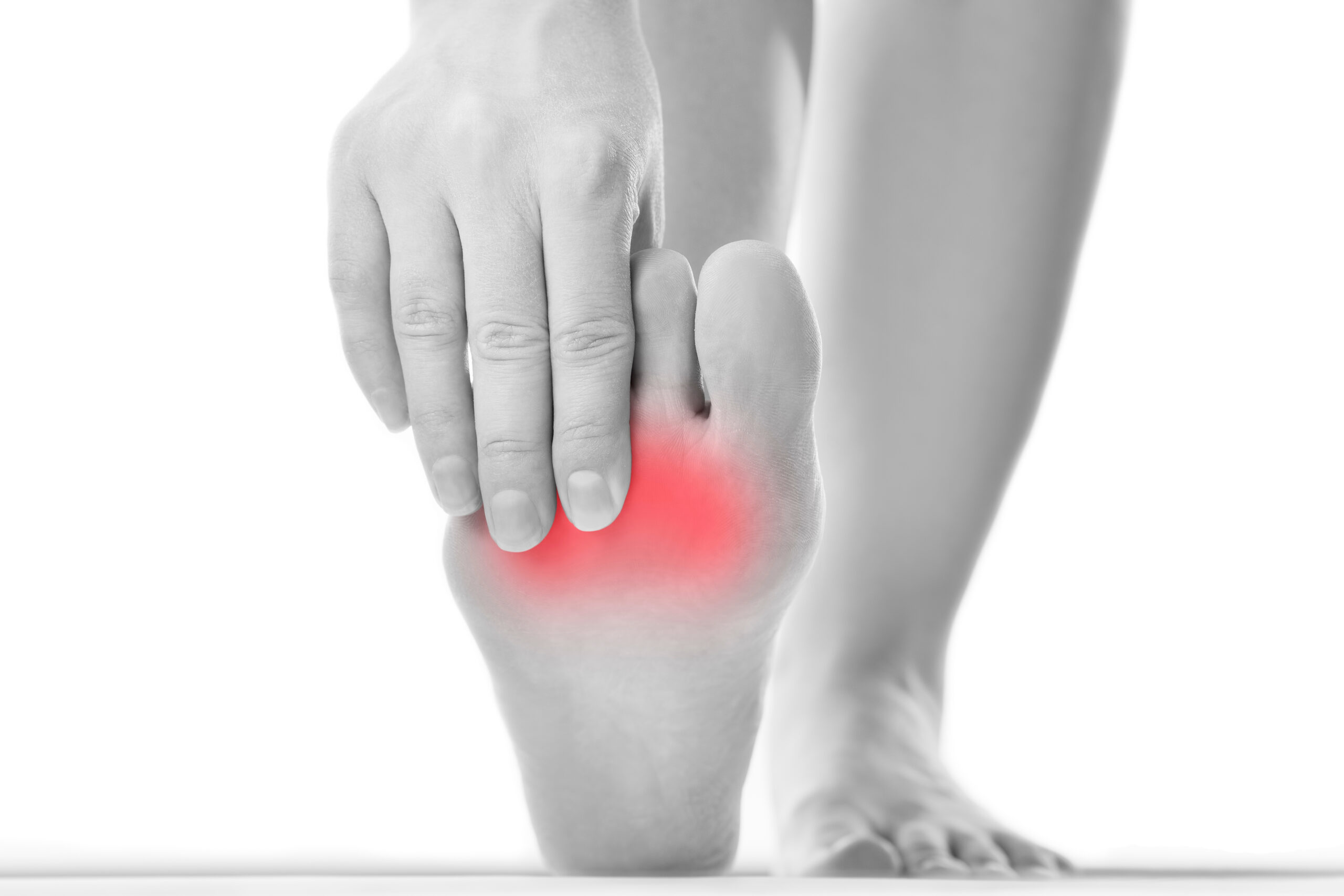
Pain is usually palpated on squeezing the foot, when putting on a tighter pair of shoes; sometimes we can even elicit a clicking sensation, known as ‘Mulders click’. Though the area between the third and fourth toes is the most common site of a neuroma, you can still find them between all other
intermetatarsal spaces.
Who is most likely to develop one?
Morton’s neuroma is most common in:
- Women between 40 and 60 years of age
- People who regularly wear narrow or high-heeled shoes
- Runners and walkers covering long distances
- Fitness enthusiasts doing high-impact exercise
- People who spend long hours standing at work
- Those with biomechanical foot issues such as overpronation or instability
While women are affected more often, we also see plenty of active men with neuromas—especially those who run, play golf, tennis or court sports.
What does it feel like?
Symptoms can range from mildly annoying to seriously painful.
Common complaints include:
- Burning pain in the ball of the foot
- Tingling or numbness in the toes
- A feeling like you’re walking on a marble or a scrunched-up sock
- Sharp, electric shock-like pain
- Pain that gets worse in tight shoes
- Relief when the shoes come off, and the foot gets a bit of a massage
Many patients tell us they instinctively stop and take their shoe off because it feels like something is stuck under the foot.
Why does it happen?
Morton’s neuroma usually develops because the nerve is being compressed over and over again.
Some of the usual suspects include:
- Tight or narrow footwear
- High heels
- Bunions
- Flat feet or excessive pronation
- High-arched feet with extra pressure through the forefoot
- Instability in the forefoot
- Repetitive impact from sport or exercise
Foot structure matters a lot here. The way your foot moves can increase pressure between the metatarsal bones, which keeps irritating the nerve with every step.
How do we diagnose it?
A thorough clinical examination is where it starts.
At Luxe Feet, we look at:
- Your symptoms and medical history
- Foot posture and biomechanics
- Walking and gait pattern
- Areas of tenderness
- Joint movement and stability
- Your footwear choices
There are also specific clinical tests that can often reproduce the symptoms, which help us determine whether the pain is coming from a neuroma, bursitis, or another forefoot condition.
If needed, we may recommend an ultrasound or MRI to confirm the diagnosis and rule out other causes such as stress fractures, plantar plate injuries or arthritis.
Treatment: The earlier, the better
The good news? Many Morton’s neuromas improve significantly without surgery.
Treatment is always tailored to the individual and may include a combination of approaches.
— — — — —
Footwear advice
Sometimes the simplest change makes the biggest difference.
A wider toe box and a lower heel can reduce pressure on the irritated nerve and often bring noticeable relief quite quickly.
— — — — —
Padding and offloading
Simple padding techniques can shift pressure away from the painful area, giving the nerve a chance to settle down.
— — — — —
Custom Orthoses
If your foot mechanics are contributing to the problem, custom orthoses can be a game changer.
Prescription orthotics can help:
- Reduce forefoot pressure
- Improve foot alignment
- Control excessive pronation
- Redistribute load during walking
- Help prevent recurrence
For many patients, addressing the underlying biomechanical issue leads to meaningful long-term improvement.
— — — — —
Local Anaesthetic Therapy
For particularly painful neuromas, a carefully placed local anaesthetic injection around the affected nerve can provide fast relief. At Luxe Feet, we can do this on the spot, at your consultation with the podiatrist.
It can also be helpful diagnostically, confirming that the nerve is the source of the pain while making it easier to walk comfortably as the inflammation settles. It can create a ‘nerve reset’ which in some cases has been shown to relieve the pain permanently.
— — — — —
Laser Therapy
At Luxe Feet, we also use Class IV laser therapy as part of a broader treatment plan for selected patients.
Laser therapy works by stimulating cellular repair, reducing inflammation and supporting tissue healing. While it doesn’t remove the neuroma itself, it may help calm the surrounding inflammation and pain—especially when bursitis is part of the picture.
It’s non-invasive, comfortable and often works best alongside footwear changes and orthotic therapy.
— — — — —
Corticosteroid Injection
If conservative treatment isn’t giving enough relief, referral for an ultrasound-guided corticosteroid injection may be the next step.
These injections aim to reduce inflammation around the nerve and can provide months—or sometimes years—of symptom relief in suitable patients. Typically, relief is obtained for up to 9 months, sometimes more. Repeat cortisone injections may be needed.
— — — — —
Surgical Referral
For persistent cases that don’t respond to conservative care, surgery may be considered.
A foot and ankle surgeon can remove the thickened nerve (neuroma excision) or perform a decompression procedure where appropriate. Thankfully, only a small number of patients need surgery when the condition is addressed early.
Don’t ignore forefoot pain
So many people put up with forefoot pain for months—or even years—thinking it’s just something they have to live with. But early diagnosis often means simpler treatment, faster relief and better long-term results.
Whether your symptoms are caused by a Morton’s neuroma, bursitis or another forefoot condition, finding the real source of the pain is the key to treating it properly.
At Luxe Feet, our podiatrists combine detailed biomechanical assessment with modern treatment options to create a personalised management plan designed to ease pain, restore function and keep you comfortably on your feet.
“Because every step should feel effortless”